Showing posts with label Rediculous. Show all posts

Wednesday, May 7, 2014


The first Thursday of May has been designated by the United States Congress and approved by the President as the “National Day of Prayer.” If government only endorsed religion just one day a year and left us with a secular government the rest of the year that wouldn’t be so bad. Sadly that is not the case. Unfortunately, the “holiday” could be called the “Day When Government Unconstitutionally Endorses Christianity Even More Than They Usually Do.”
According to the National Day of Prayer website, their mission is to “mobilize prayer in America.” Interestingly enough, they don’t seem to stop when the day is over. The people who support this “holiday” treat every day as a National Day of Prayer.
The reality is that the first Thursday of May is just an excuse for religious elements in our government to openly ignore the principle of church/state separation. Even though many government officials have no problem violating church/state separation with regard to religious invocations at the beginning of legislative and judicial sessions, voting for religious language in our national motto and on our currency, recognizing religious holidays as national holidays, favored tax-exempt status for religious groups and churches, and allowing purely religious arguments to dictate many of our laws, they at least have the decency to play lip-service to the Jeffersonian wall of separation between church and state.
But on the National Day of Prayer, all that goes out the window. The President goes to a prayer breakfast where he elevates religion over non-religion in an official capacity, and legislatures around the nation actively endorse religious belief, alienating atheists and other secular-minded citizens.
I would almost give the National Day of Prayer a pass if the other 364 days a year religious believers weren't trying to use government to endorse their religious beliefs. As a result, this day just seems like it is an amplification of the already existing problem. It has become a day in which the lunatics are openly allowed to run the asylum.
The worst part is that we know prayer doesn't work, and in some cases prayer can even be dangerous. Instead of a day of prayer on steroids, we need 365 days of a secular government that does not endorse the use of prayer at all. What we really need is 365 days of reason.

Source:  Staks Rosch Atheism Examiner

Tuesday, May 6, 2014

Godless Church Services for Atheists Go Global

Congregations for atheists are springing up all over the planet. There’s already a schism: celebrate life without a deity, or preach atheism. The celebration is winning.
Plans to set up almost 400 “atheist churches” on five continents are underway after the extraordinary success of one small congregation that began holding godless services just over a year ago.


Word about the religion-free church spread like wildfire after the first Sunday Assembly was held in a deconsecrated church in Highbury, North London, in January 2013. By September, 100 congregations will be holding services from Singapore and South Africa to Sao Paulo and San Diego. A further 274 teams currently are working on plans to launch their own assemblies.
The church’s first General Assembly is being held this weekend with leaders from all over the world gathered in South London. In 150 years of the Anglican Church’s Lambeth Conference, it’s safe to say none has begun quite like this--with a raucous group karaoke rendition of “I’m So Excited,” but then Sunday Assembly is a very different kind of world religion. Their gatherings resemble traditional church services with singing, lessons and the chance to interact with members of the community. The only thing missing is God.
Sanderson Jones, the group’s leader and CEO, and a stand-up comedian by trade, says the young organization is replicating the traditional church structure as it expands. But he says the empire is also attempting to harness the organizational knowhow and social interaction of Grindr and the National Rifle Association.
“We’re right on the buckle of the Bible Belt. … A lot of people tell me I’m going to Hell.”
“This is the first time we’re coming together like this,” he said. “We’ve had such a short time but I think we’re going to build something magnificent, something that’s going to last.”
The group’s rapid expansion has caught everyone by surprise. It is currently growing by 26 per cent each month but there is no end to Jones’ ambitions. “There are 1.1 billion non-religious people in the world,” he told The Daily Beast. “We want to have a godless congregation in every town, city and village that wants one.” In other words, as he told the gathering of leaders on the opening day of the conference: “We’re going to need a bigger boat.”
140503-hines-atheist-church-embed
LEON NEAL/Getty
In order to help as many people set up assemblies as possible, Jones has started to study the mechanics of running a huge organization. “My Twitter feed has got a lot less funny -- people are wondering ‘why is he retweeting a pdf of different corporate governance structures in social enterprises?’” he said. The research has led him to marvel at the N.R.A., one of the few organizations with what is considered the holy trinity of benefits and service, a membership community and a media platform. “Another good example is Grindr and Tinder,” says Jones. “If St Paul was alive today he wouldn’t be writing letters he’d be writing code.”

Jones is constantly exploring ways to create an equally efficient network with even bigger growth potential, but this weekend before he got down to all that, it was time to get down. The lyrics of the second track of Saturday’s musical opening, Pharrell Williams’ “Happy,” were projected on a big screen.

Clap along if you feel,
Like that’s what you wanna do.


They did. Two women from The Netherlands swayed from side-to-side; an enthusiastic chap from Newcastle, in the northeast of England, danced in front of his seat in the auditorium; and a broad-shouldered man with graying dreadlocks from Tennessee clapped in time with the music.

 That man was Landry Butler, 46, a designer from Nashville, who became co-organizer of his local Sunday Assembly back in November. He was raised in a deeply Christian family, who often took him to three different church services every weekend. “I gave it up for Lent,” he said with a deep laugh. “We’re right on the buckle of the Bible Belt. More than 90 percent of people in Nashville are Christian and not everyone approves of what we’re doing. A lot of people tell me I’m going to Hell.”
“My mother didn’t want to talk about it until I appeared in the newspaper, and then she got interested,” said Butler. “She still says she’s praying for me, but that’s okay. We’re not trying to sell atheism - it’s not for me to get involved, no matter what stupid crap people believe.”

While Butler is setting up an atheist bulkhead in a deeply religious area, Jan Willem van der Straten is operating in a totally different environment. The 24-year-old is working to open the first Sunday Assembly in Amsterdam in September. He was brought up in a secular family, and his parents were stunned when he started taking an interest in religion. He still describes himself as a Christian.

“People used to say: ‘Ah, Willem, you can have a good beer with him, but he’s got this funny religion thing.’ For the first time this is a church that my friends might want to come to,” he said. “I don’t have the baggage of religion; I have the baggage of atheism.”

As the assemblies multiply and spread, the disparity between communities has thrown up a series of issues. One of the hot debates to be decided this weekend is whether to continue to use the word “godless.” For those in countries where religion has receded in recent generations it feels more natural to say Sunday Assembly is a "celebration of life." The American chapters argue that everyone would assume it was a religious group if you didn’t explicitly explain otherwise.

The continued prominence of Christian belief in the U.S. also affects the way atheism is seen. The church suffered its first schism earlier this year when New York organizers fell out with the founders over the strength of the anti-religious teaching. “They wanted to do a celebration of atheism not a celebration of life,” said van der Straten, who has been working at the London headquarters for the past three months.

The genius of Sunday Assembly is that it shares far more with an ordinary church service than it differs. There have been scores of atheist groups in the past, but few have attracted such warmth and affection.

“The thing that we’ve got is that we’re the only non-religious service that works. Rationality is part of it, but we also have the emotional connection,” Jones said. “We are speaking to the whole human.”
Sunday Assembly is already talking to an awful lot of humans. Jones wonders if they might manage to start 2015 congregations by 2015. “It might just be a little bit historical if it goes on like this. We could have a profound impact,” he said. “Throughout history there’s been these moments when an idea takes off: the Great Awakenings. We could suddenly create a great moment.”

American Atheist

Embrace of Atheism Put an Indonesian in Prison.


JAKARTA, Indonesia — Growing up in a conservative Muslim household in rural West Sumatra, Alexander Aan hid a dark secret beginning at age 9: He did not believe in God. His feelings only hardened as he got older and he faked his way through daily prayers, Islamic holidays and the fasting month of Ramadan.

He stopped praying in 2008, when he was 26, and he finally told his parents and three younger siblings that he was an atheist — a rare revelation in a country like Indonesia, the world’s most populous Muslim-majority nation. They responded with disappointment and expressions of hope that he would return to Islam.

But Mr. Aan neither returned to Islam nor confined his secret to his family, and he ended up in prison after running afoul of a 2008 law restricting electronic communications. He had joined an atheist Facebook group started by Indonesians living in the Netherlands, and in 2011 he began posting commentaries outlining why he did not think God existed.

“When I saw, with my own eyes, poor people, people on television caught up in war, people who were hungry or ill, it made me uncomfortable,” Mr. Aan, now 32, said in an interview. “What is the meaning of this? As a Muslim, I had questioned God — what is the meaning of God?” He was released on parole on Jan. 27 after serving more than 19 months on a charge of inciting religious hatred.

Indonesia’s state ideology, Pancasila, enshrines monotheism, and blasphemy is illegal. However, the Constitution guarantees freedom of religion and speech, and the country is 16 years into a transition from authoritarianism to democracy.

But Mr. Aan’s case is one of an increasing number of instances of persecution connected to freedom of religion in Indonesia in recent years. Although Indonesia has influential Christian, Hindu and Buddhist minorities, every year there have been hundreds of episodes, including violent attacks, targeting religious minorities like Christians and Shiite and Ahmadiyah Muslims, as well as dozens of arrests over blasphemy against Islam. Numerous churches have been closed for lacking proper permits.

According to human rights organizations and various surveys, religious intolerance is on the rise in Indonesia, at least partly because of the growing influence of radical Islamic groups that use street protests and acts of violence to support their aims. Some of these radical groups demonstrated in Jakarta, the capital, before Mr. Aan’s trial in West Sumatra in 2012.

“His case very much ties in with that whole trend,” said Benedict Rogers, the East Asia team leader for Christian Solidarity Worldwide, a human rights organization founded in Britain. The group released a report in February warning that religious intolerance in Indonesia was spreading beyond traditionally conservative Muslim bases like West Java Province.

“Of course there would be religious people who would take offense about someone publicly expressing this view” about atheism, Mr. Rogers said. “But I think if it weren’t for this growing Islamism and extremism, Alexander’s case probably wouldn’t have happened.”
Mr. Aan’s troubles began in January 2012 when a mob in the Dharmasraya district of West Sumatra showed up looking for him at a government planning office where he worked as a data analyst.
“They wanted me to stop saying there is no God,” he said. “I told them that it was my right to express my beliefs.”

Police officers were called to prevent any violence, and they instead escorted Mr. Aan to the local police station, where he found himself being interrogated and, within hours, charged with disseminating information aimed at inciting religious hatred. The next day, he was charged with blasphemy and inciting others to embrace atheism.

A court in Padang, the capital of West Sumatra Province, threw out the blasphemy and atheism charges, but it convicted Mr. Aan in June 2012 of trying to incite religious hatred under the electronic information law and sentenced him to two and a half years in prison.

“What I posted was for discussion, not to incite hatred,” he said in the interview.

Mr. Aan’s case was among several controversial prosecutions over comments made on the Internet in Indonesia, where Twitter and Facebook are extremely popular.

A homemaker was jailed and charged with defamation in 2009 after complaining about what she said was an incorrect hospital diagnosis in a private email that found its way online. In February, a Twitter user was sentenced to a year’s probation for “libelous tweets” against a former national lawmaker who had been convicted and sent to prison for corruption.

“It’s funny — we say we have freedom of expression, but it’s only up to a certain point,” said Enda Nasution, an Indonesian blogger. “I think we are absorbing all of these new norms, and with the Internet, we are experimenting with what we can and can’t do. Atheism is a no-no, it seems.”

Christian groups and religious and human rights advocates say that rising religious intolerance is also linked to the efforts to promote regional autonomy in Indonesia in 1999 as part of the country’s transition to democracy after three decades of highly centralized, authoritarian rule under President Suharto.

More than half of Indonesia’s 491 provincial districts have enacted various bylaws inspired by Islamic law, or Shariah, in recent years.

“So much power was given to local authorities, and in many cases — in particular in regions where Muslim organizations dominated — there were violations against religious freedom, and freedom, for example, for someone to say they are an atheist,” said Theophilus Bela, secretary general of the Indonesian Conference on Religions for Peace, a nongovernmental organization focused on interfaith dialogue.

While serving his prison sentence, Mr. Aan lay low, reading books and playing chess, and he said that by the end of his time behind bars, he had gone from being an outcast to having friends among his fellow inmates. Now, he is preparing to apply to universities to pursue a master’s degree in physics.
“My case was a religious issue and a human rights issue, both because Indonesia is a Muslim country and because it’s a developing country and new democracy,” he said. “I was just searching for the truth, and everything I felt, I expressed.”

These days, Mr. Aan said, he is still active on Facebook and Twitter, but he never mentions religion or his criminal case.

Monday, October 31, 2011

Bad Reasons to Believe in God

Posted by grimachu on 31/10/2011


It is quite often argued by proponents of the Abrahamic faiths that god, whichever god it is, is the ultimate and inviolate source of humanity and that somehow the existence of our conscience, our guilt when we do bad things, is evidence for this god.

Needless to say there are problems with this.
  1. The god described in their holy books is a capricious, violent, hypocritical fuckwit of the first order. Dawkins puts it more poetically but you can find his description for yourselves here "The God Delusion""". Suffice to say if you’re looking for a perfect moral guide a mass-murdering torturer and engineer of genocide isn’t a safe bet.
  2. Morality does change, it’s subjective. One can see that even through the books. Christians would even argue themselves that the New Testament overrides the old (even though it explicitly says it doesn’t) but to argue that moral systems can change is to argue that god is not all knowing or perfect since otherwise he’d have gotten it right first time. Different cultures, different times, different morals. This is particularly difficult for Muslims since Mohammed was, by any remotely modern standard, a kiddie fiddler. Try asking them if screwing children is wrong and, well… see what happens. Morality is also situational, stealing to feed a starving child would – for example – be considered good.
  3. Our conscience can enforce any moral system with which we’re ‘programmed’. While certain very broad and general moral rules seem to apply across humanity these are extremely basic and can be accounted for through evolutionary psychology and our existence as a social species (altruism good, selfishness bad). Whatever morality you’re brought up into, otherwise, will determine what you feel good, bad or indifferent about.

Source: Athefist


Enhanced by Zemanta

Vote Republican? I Say Vote Atheist.

I glanced over a poll somewhere claiming that people are far more likely to vote for a presidential candidate who holds Christian or Catholic beliefs than a candidate who is an Atheist. As a devout Atheist (I pray to my very own nonexistent deity called science), I felt obligated to write.


I first read about Russel’s teapot in Richard Dawkins’The God Delusion.” Allow me to paraphrase.


If I were to tell you a teapot was floating in orbit around the sun between the Earth and Mars that was too small to detect by any of our current technology, would you believe me? What if someone had written about this teapot for several centuries and claimed this ceramic kettle created everything in existence? Seems a little farfetched, no? I’m sorry, I just can’t grasp the idea that a teapot cast the 10 plagues over Egypt, let alone that it even exists.


“Man would indeed be in a poor way if he had to be restrained by fear of punishment and hope of reward after death.” – Einstein


I reject that a society can be so invested in the religious beliefs of its leader. There is absolutely no justification to do so. If we’ve learned anything from history it’s that religion is simply a game we play to legitimize imperialism.


You don’t need a deity to tell you the difference between right and wrong. You certainly should not rely on an unknown entity to define success.


Recently I find myself taking the stance opposed to someone just for the sake of debate. Regardless of my actual perspective, I disagree because I can. However, I argue against religious beliefs because they are absurd. There are no direct benefits of having a religious belief, but there are certainly disadvantages:


1. You lose your free will. You’re now a follower.
2. Fear of punishment. Hope for reward after death. (Einstein’s elegant words)
3. Your time.
4. Your money.
5. Idealism. You must deal with the fact that you were not created in the image of your deity. Nothing has been made perfect.
6. False goals. Successful leaders, businessmen, professors, etc. did not get to where they are because of “good” deeds. If your ultimate goal is to reach your heaven, you cannot succeed in life.


So next time you go to the polls, think and vote Atheist.


Enhanced by Zemanta

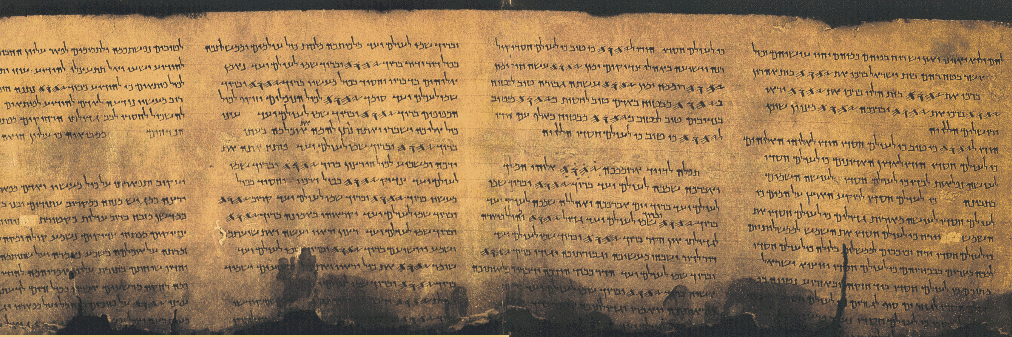
The Books of the Apocrypha

FULL LIST OF EXTRA-BIBLICAL WRITINGS
 

To explain simply, the apocrypha and pseudepigrapha are collections of writings which were not included in the Bible for various reasons.  There is a lot written on this subject and I encourage you to research the history of the Bible. They key, however, is that the Bible is trustworthy and reliable and if it wasn't (for example, if it contained false information), it would have to be thrown out and would not be the Word of God. The Bible has stood the test of time and archeological discoveries have always proven the Bible to be true. The apocrypha and pseudepigrapha were not included for many reasons but namely because they didn't pass the stringent tests required in the long process of assembling God's Word into one book called the Bible. You will be amazed at the care taken in this process!


Roman Catholics sometimes call some of these writings Deuterocanonical, meaning "Second Canon" and some are often included in a middle section of Catholic Bibles but not considered equal in authority and inspiration as the Canon.


Protestants typically call these writings the Apocrypha. The term “apocrypha” comes from a Greek word meaning “hidden”, or “things hidden away”. In modern jargon, the word is often used to describe things that are spurious, or of questionable authority.


The Pseudepigrapha (sued-a-PIG-ruffa), whose Greek, meaning is "false subscriptions," is a group of Jewish and Jewish-Christian texts primarily written between 250 B.C.E. and 200 C.E. These books are not included in any Bible, Apocrypha, or even rabbinic literature. Of course, some books in the Apocrypha are also written with “false subscriptions” – Baruch, Letter of Jeremiah, 2 Esdras, Wisdom of Solomon, etc., adding to some of the confusion surrounding what books are considered to be part of the Apocrypha, and what books are part of the Pseudepigrapha.


It is widely accepted why these books were not included in the Canon, and it is also pretty clear where they are considered inaccurate. With that in mind, they still contain a lot of beneficial information and I have enjoyed studying a lot of these books as a supplement to my regular Bible reading. Keep in mind it is much more important to read the Bible, not false writings.

This is the largest list of it's kind anywhere on the Internet (and has working links!) and includes the apocrypha/deuterocanonical writings, the pseudepigrapha, other extra-biblical writings, and some historical works.


2 Clement


Amram, Vision of [Not Online]


Baralâm Yewâsef (Barlaam and Josaphat) [Wiki


Cernithus, Revelation of [Missing]


Colossians, Epistle from Laodicea to the [Missing]

Community Rule [mirror] [mirror] (aka The Manual of Discipline/Serekh ha-Yahad)


Criapos, Books of  [Missing]


David, The Annals of King [Missing]


Didache [mirror] [Wiki] [mirror] [more info] (aka The Teaching of the Twelve Disciples/Apostles)


Giants, The Book of [mirror] (aka The Writing to the Parthians)


Hesychius, False Gospels of the [missing]


James, The Gospel of, Infancy [Wiki] [mirror] [more info](aka The Protevangelion/Protevangelium)


Joshua, Psalms of [Not Online]


Legends of the Jews (Ginzberg)  - This is a massive collation of the Haggada--the traditions which have grown up surrounding
the Biblical narrative. These stories and bits of layered detail are scattered throughout the Talmud and the Midrash, and other
sources, including oral. In the 19th century Ginzberg undertook the task of arranging the Haggada into chronological order, and this
series of volumes was the result.


Matthew, Infancy Gospel of Pseudo- [mirror] [mirror] [mirror] (aka Gospel of Pseudo-Matthew)


Moses, Sayings of [Not Online]


Mysteries, Book of [Not Online]


Perfection, Gospel of [Missing]


Peter and Paul, Epistle to [missing]


Philo the Epic Poet (aka Philo the Elder)


Protevangelion, The [mirror] [mirror] [more info] (aka Protevangelium of James, Gospel of James, Infancy)


Quadratus of Athens, Asinius (Fragments) [Not Online]
Rechabites, History of the [more info] [original Greek] [Wiki] [Paper]


Sapiential Work [mirror] (aka Secret of The Way Things Are, The)


Scythianus, Gospel of [Missing]


Seleucus, The Suffering of the Apostles [Missing]   


Three Patriarchs, Testaments of the [Not Online]


Uziah, Acts of [Missing]